AI and paid partnership labels on social media: what each network asks you to disclose
When YouTube, TikTok, Instagram, Facebook, LinkedIn, X and Bluesky expect an AI or paid label, where the setting lives, and five posts worked through.
Bu makale yalnızca İngilizce olarak mevcut.
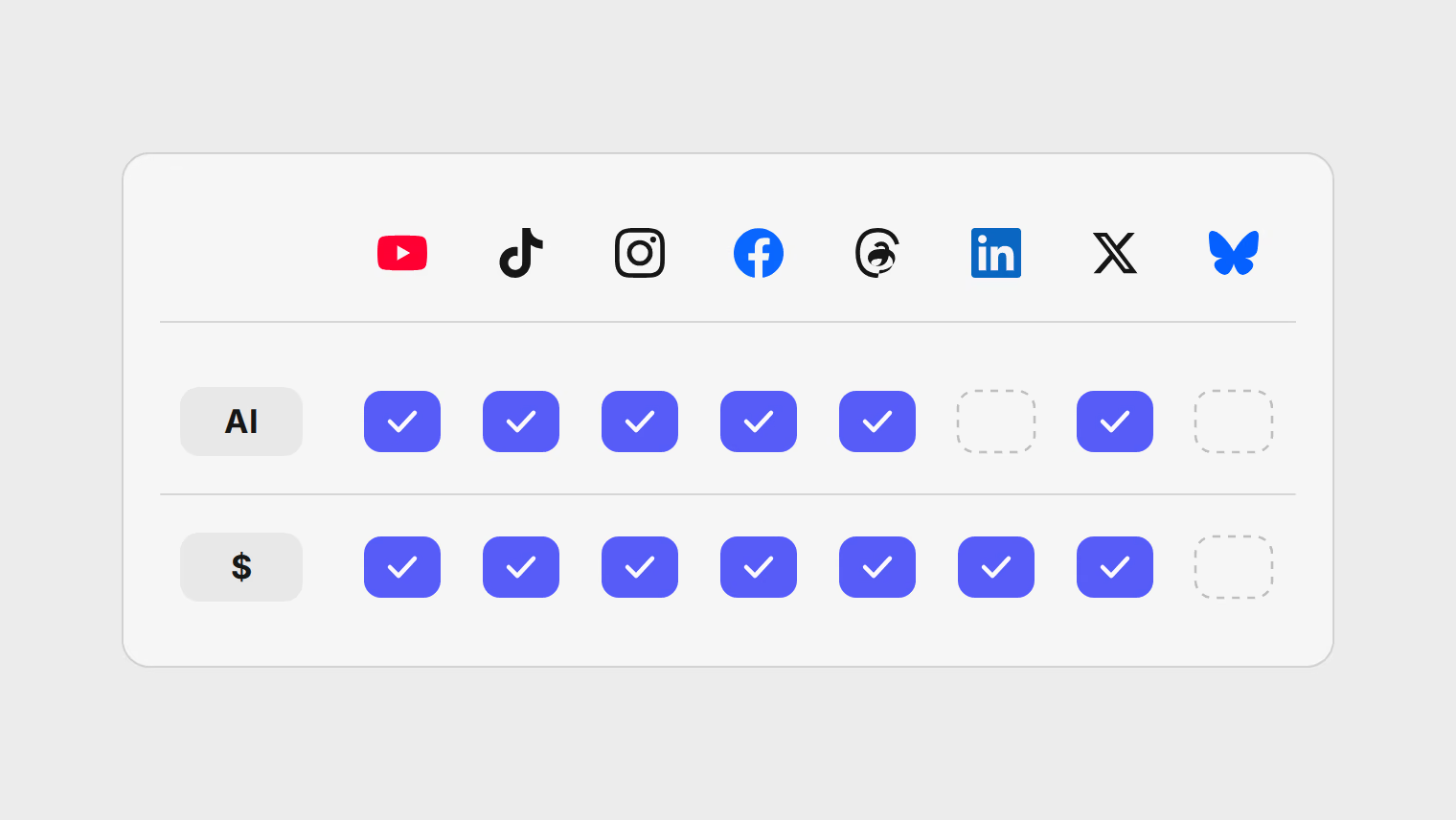
Most networks now ask two questions before a post goes out: did AI make or change something in it that looks real, and is someone paying you for it? The answers become labels: "Creator labeled as AI-generated" on TikTok, "AI info" on Instagram and Facebook, an AI disclosure on YouTube videos, and a paid partnership label on most networks. The rules differ in what triggers them, where the setting lives, and whether the network can add the label for you.
This guide sets out each network's rule from its own help pages and policies, read on 18 October 2026, then works through five ordinary posts. It is not legal advice; it tells you what each network asks for and where to set it.
The short version
- Realistic AI content needs a label on YouTube, TikTok, Instagram, Facebook and Threads. A cartoon, an obviously impossible scene or a light retouch usually does not.
- Paid content needs the network's own tool on YouTube, TikTok, Instagram, Facebook, Threads and LinkedIn, not only "#ad" in the caption. Meta's policy says branded content may only be posted with its branded content tool.
- The tool is not the whole job. The US Federal Trade Commission says a built-in label that is easy to miss is not a clear disclosure. Say it in the caption or the video too.
- Some labels are added for you. YouTube, TikTok, Meta and LinkedIn read Content Credentials (C2PA metadata) that some AI tools attach to files, and some of those labels cannot be removed.
AI labels, network by network
| Network | What needs a label | Where you set it | Added automatically |
|---|---|---|---|
| YouTube | Realistic content that was generated or meaningfully altered: a real person saying or doing something they did not, altered footage of a real event or place, a realistic scene that never happened, AI music as the main focus | YouTube Studio, Attributes, "AI use" | Yes, for YouTube's own AI tools, C2PA metadata and content its systems detect |
| TikTok | All AI-generated content with realistic images, audio or video | The AI-generated content setting when posting | Yes, for TikTok AI effects and C2PA Content Credentials; that label cannot be removed |
| Instagram, Facebook, Threads | Photorealistic video or realistic-sounding audio that was digitally created or altered | Meta's AI disclosure option when posting | Yes, when Meta detects industry-standard signals; shown as "AI info" |
| Synthetic or manipulated media that shows a person saying or doing something they did not, unless clearly disclosed | In the post itself; some countries also get an option to self-attest AI | Shows a Content Credentials icon on images and video that carry C2PA data | |
| X | Synthetic or manipulated media shared deceptively in a way likely to cause harm is not allowed; X's API has a "made with AI" flag for posts | Where X offers it | X may add a "Manipulated media" label, and in the EU shows "Made with AI" indicators |
| Bluesky | No AI label. Self-labels exist only for adult and graphic content | Content warning on the post | No |
Three details from the source pages are easy to miss.
YouTube draws the line at realistic and meaningful. Its examples of what you do not have to disclose include beauty filters, colour correction, background blur, AI help with a script, title, thumbnail or outline, auto captions, upscaling, and cloning your own voice to dub your own video. AI-generated extra footage of a real place for a travel promo does need the label. YouTube also says disclosure on its own will not limit a video's audience or its ability to earn money.
TikTok and YouTube may label it for you, permanently. Both read Content Credentials, the C2PA metadata some image and video generators write into files. On TikTok, an automatic "AI-generated" label cannot be taken off. On YouTube, a label that came from C2PA data or YouTube's own tools cannot be changed either. If you export from an AI tool that writes Content Credentials, expect the label whether or not you set it.
Meta's label changed name. Meta started with "Made with AI" in 2024, then renamed it "AI info" in July 2024 because light retouching with AI tools was triggering it. Content that was only edited with AI now shows the label in the post's menu, not on the post.
Paid partnership labels, network by network
| Network | Rule | Setting | Label viewers see |
|---|---|---|---|
| YouTube | Disclose branded content, sponsorships, endorsements and other commercial relationships | Paid promotion in video details | A disclosure at the start of the video |
| TikTok | Turn on the commercial content disclosure toggle for branded content; make the product clear without a trip to your profile or a link | Content disclosure: "Your brand" or "Branded content" | "Promotional content" for your own brand, "Paid partnership" for a third party |
| Instagram, Facebook | Branded content may only be posted with the branded content tool, tagging the partner with their permission | The branded content tool and partner tag | A paid partnership label naming the partner |
| Threads | Meta's branded content policies require the paid partnership tool when a business partner influenced an organic post | The paid partnership tool on the post | A paid partnership label |
| X | A paid partnership posted as an organic post must have the "Paid Partnership" disclosure on | Content Disclosure settings when creating the post | A Paid Partnership label, added automatically when the disclosure is on |
| Label any post shared in exchange for value (payment, endorsements, free products or services) as a brand partnership | Brand partnership toggle when posting; public posts only | "Brand Partnership"; labeled posts are publicly searchable | |
| Bluesky | No paid label | Say it in the text | None |
Three of these rules go further than a label.
LinkedIn's toggle only works on public posts. Switch a post to Connections only or a group and the toggle turns off until the post is public again, and LinkedIn makes every labeled post publicly searchable.
Meta defines branded content as content that "features or is influenced by a business partner for an exchange of value, such as monetary payment or free gifts". A gifted product counts. The same policy forbids some categories outright and requires Meta's written approval for others, so check it before you accept a deal in a regulated industry.
TikTok's API rules show how strict its toggle is. Any app that posts to TikTok has to offer the disclosure switch, show which label will appear, block publishing until you pick "Your brand", "Branded content" or both, and refuse "Only me" visibility for branded content. Where a tool does not show these switches, such as TikTok accounts connected the other way in Publedia, post paid TikToks from the TikTok app, where all of them are available.
Why the built-in label is not enough
In the US, the FTC's guidance on endorsements asks for a disclosure people actually notice, and it includes this example: an influencer relies only on a platform's built-in disclosure tool, the label appears in small white text on a light image, competes with other text, and is on screen for five seconds. The FTC's conclusion is that it "is easy to miss and thus not clear and conspicuous" (16 CFR 255.0, Example 9). The same example says a disclosure only on a profile page, or behind a "more" link, also fails.
The EU adds a second layer for AI. The AI Act requires anyone who uses an AI system in a professional capacity to produce a deep fake (image, audio or video that resembles real people, places or events and could pass as real) to disclose that it was generated or manipulated. Text published to inform the public on matters of public interest needs the same disclosure, unless a person reviewed it and someone holds editorial responsibility. As published, those rules apply from 2 August 2026 (Article 50, with dates in Article 113). Check EUR-Lex for later amendments before relying on the date.
Five posts, worked through
| The post | AI label? | Paid label? | Why |
|---|---|---|---|
| A sponsored skincare video posted to TikTok, Reels and Shorts | No | Yes, on all three | Paid content needs Branded content on TikTok, the paid partnership tag on Instagram and Paid promotion on YouTube, plus a spoken or written disclosure |
| A product sent free by a brand, reviewed on Instagram with no payment | No | Yes | Meta counts free gifts as an exchange of value; the FTC lists free products as a material connection, whether or not the brand asked for a post |
| A realistic AI image of your CEO on stage at an event that did not happen | Yes | No | Realistic depiction of a real person and a scene that never occurred. Label it everywhere, and say so in the text on LinkedIn and Bluesky, which have no AI label in the composer |
| A cartoon illustration from an image generator, used as a blog post's header | Usually no | No | Not realistic. TikTok and YouTube may still label it if the file carries Content Credentials |
| Your own voice, cloned to dub your video into Spanish | No on YouTube | No | YouTube lists cloning your own voice for dubs as a use you do not need to disclose. The other networks' pages do not mention it either way |
Decide the two answers once per piece of content, before you adapt it for each network, then set them in each network's own place. If you post one video to TikTok, Reels and Shorts, that is one decision and three settings.
Setting labels from a scheduler
A scheduler can only set a label the network exposes through its API. YouTube's API has fields for synthetic media and paid product placement, TikTok's has the AI-generated flag and both disclosure toggles, and X's has paid partnership and "made with AI". Tools differ in which of these they offer, so check each label in yours before you rely on it.
In Publedia, the channel settings in Create post include Paid partnership for X, Altered or synthetic content for YouTube and Content warning for Bluesky. YouTube's Paid promotion is not set through Publedia; turn it on in YouTube Studio. TikTok accounts connected directly also get TikTok's content disclosure switches (Your brand, Branded content) and AI-generated content; TikTok accounts connected the other way do not. LinkedIn's Brand partnership toggle and the paid and AI labels for Instagram, Facebook and Threads are not set through Publedia today, so publish paid or realistic AI posts to those networks from their own apps, where the label options are. The TikTok scheduling guide and the YouTube Shorts guide cover the rest of each network's settings.
A disclosure checklist before you schedule
- Did AI create or meaningfully change anything that looks real: a person, a voice, a place, an event? If yes, plan the AI label on every network that has one.
- Is anyone paying you, giving you something, or otherwise connected to what you show? If yes, plan the paid label and a written or spoken disclosure.
- Does the file come from an AI tool that writes Content Credentials? Expect an automatic label on TikTok, YouTube, Meta's apps and LinkedIn.
- For each network, can your tool set the label? If not, post that version from the network's app.
- Is the disclosure visible without a tap? Put it in the first line or say it on screen.
- For EU audiences, is the content a deep fake or AI text on a matter of public interest? Disclose it.
Kaynaklar
- YouTube Help, disclosing use of GenAI content (read 2026-10-18)
- YouTube Help, branded content restrictions and disclosure labels (read 2026-10-18)
- YouTube Data API, videos resource (synthetic media and paid placement fields)
- TikTok Support, AI-generated content (read 2026-10-18)
- TikTok, Branded Content Policy (read 2026-10-18)
- TikTok for Developers, content sharing guidelines
- Meta, labeling AI-generated images on Facebook, Instagram and Threads (February 2024)
- Meta, our approach to labeling AI-generated content (updated July 2024)
- Meta Business Help Center, branded content policies (read 2026-10-18)
- Instagram Help Center, use the paid partnership tool to tag organic branded content on Threads (read 2026-10-18)
- LinkedIn Help, content credentials
- LinkedIn Help, label post as brand partnership (read 2026-10-18)
- LinkedIn Professional Community Policies
- X API reference, create post (paid_partnership and made_with_ai fields)
- X Help, Paid Partnerships Policy
- X Help, synthetic and manipulated media policy
- X Help, Media Literacy Action Plan ("Made with AI" indicators in the EU)
- Bluesky lexicon, self-labels (com.atproto.label.defs)
- eCFR, 16 CFR Part 255, Guides concerning use of endorsements and testimonials in advertising
- EUR-Lex, Regulation (EU) 2024/1689 (Artificial Intelligence Act), Articles 3, 50 and 113
Konular
- AI labels
- Paid partnership
- Disclosure
- YouTube
- TikTok